
Basic Concepts and Indian Mythology
Published January 1, 2021
The Origin of the Palm Leaf
In the context of destiny readings for individuals visiting palm leaf libraries in India for their personal reading inscribed upon a palm leaf, Indian (Hindu) mythology plays a vital foundational role.
The predictions of individual human destinies written on palm leaves originated as dialogues between Indian deities and sages, or between sages and their disciples.
These unique and mystical readings of human destinies were inscribed thousands of years ago by ancient Indian sages known as rishis. The divine communion and connection between Indian deities and rishis is described throughout Indian epics, notably in the Mahabharata, Upanishads, Rigveda, Puranas, and related sacred scriptures.
The principal Hindu divine trinity comprises Brahma, Vishnu, and Shiva. In Christianity, a comparable trinity exists as the Father, the Son, and the Holy Spirit; in Greek mythology, Zeus, Poseidon, and Hades.
The nature of Indian deities is manifold and rests on the understanding that all existence possesses a beginning, middle, and end. This is deeply linked with the cyclical Hindu perception of cosmic time, distinct from Western linear views.
Brahma
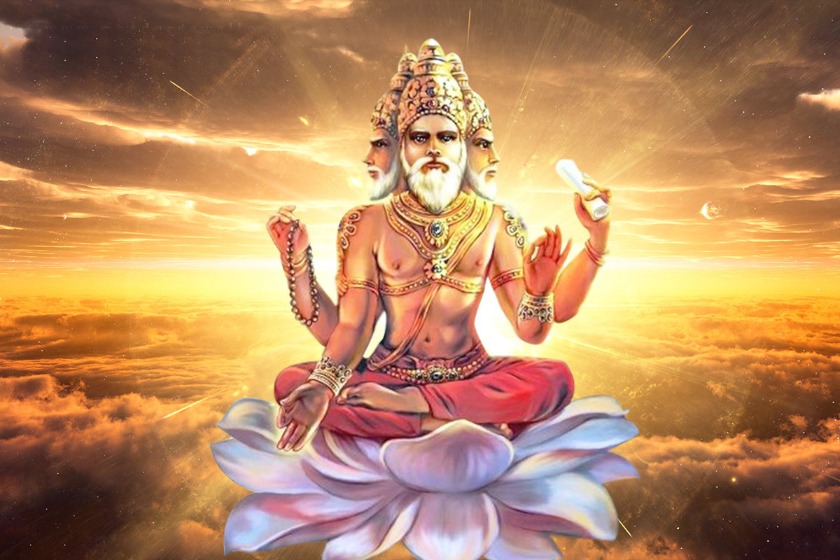
Lord Brahma is revered in Indian mythology as the creator of the universe. In sacred epics, his central role is preserving balance between the centripetal force of Vishnu and the centrifugal force of Shiva. He is conventionally depicted seated in the lotus posture upon a lotus flower, endowed with four heads, four arms, and reddish skin.
Unlike many Hindu deities, he bears no weapons in his hands. His sacred vehicle (vahana) is the goose (Hamsa).
Lord Brahma’s consort is Goddess Saraswati (“the flowing one”). She is the goddess of speech, wisdom, learning, and fine arts. Devotees believe Goddess Saraswati grants moksha—the ultimate spiritual liberation from the perpetual cycle of birth, death, and rebirth.
Vishnu
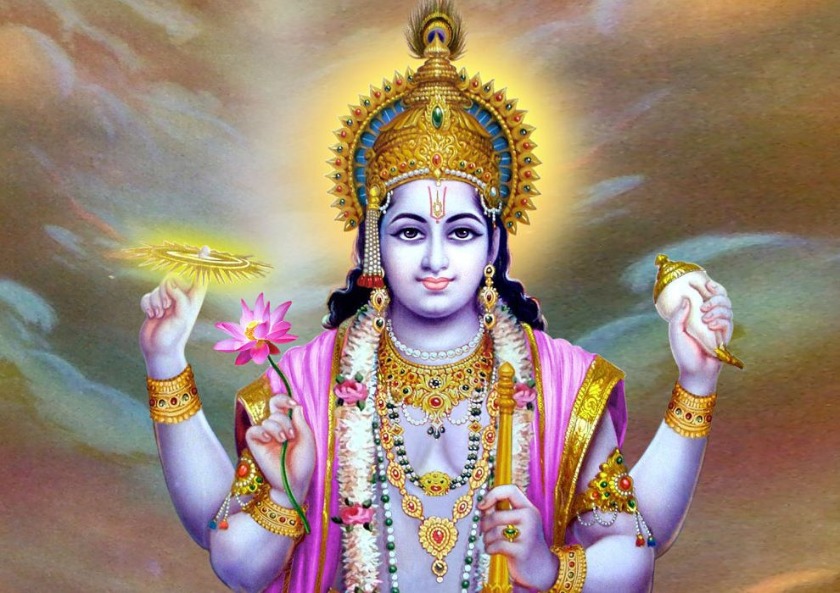
Lord Vishnu is revered as the preserver and protector, personifying cosmic stability, righteousness, and order. He is depicted as a celestial sovereign who descends periodically to Earth across ten avatars (incarnations) to restore equilibrium between constructive and destructive forces.
Vishnu’s consorts are Bhudevi, goddess of the earth, and Lakshmi, goddess of spiritual and material abundance. His celestial vehicle is the divine eagle Garuda.
Shiva
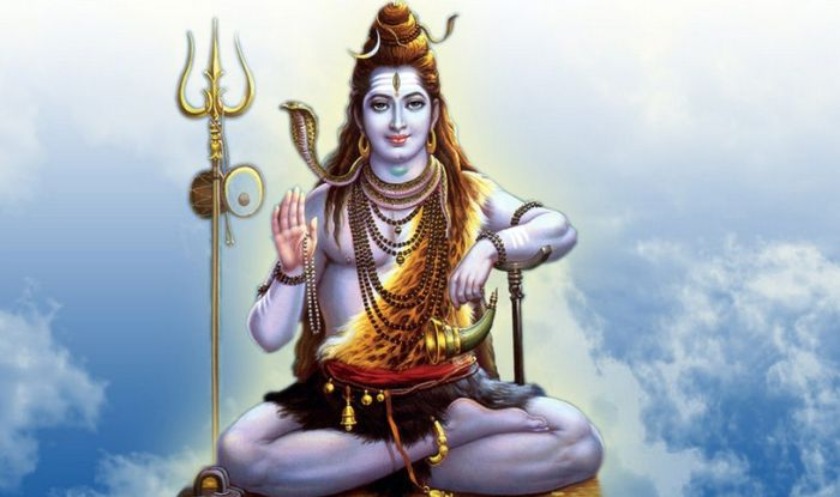
Lord Shiva (“the auspicious one”) represents the transformative aspect that dispels darkness, ignorance, and negativity, safeguarding all beings throughout the universe.
The primary emblem through which Lord Shiva is worshiped across temples is the Lingam, traditionally enshrined upon the Yoni base representing the female creative principle. This union embodies the divine harmony of masculine and feminine cosmic energies that animates all life.
Another renowned depiction of Shiva is Nataraja (“Lord of the Dance”), expressing the five divine cosmic powers. Shiva’s consort is Goddess Parvati (“daughter of the mountains”), and his sons are Lord Ganesha (the remover of obstacles) and Lord Murugan (Kartikeya). Shiva’s sacred mount is the white bull Nandi.
The Rishis
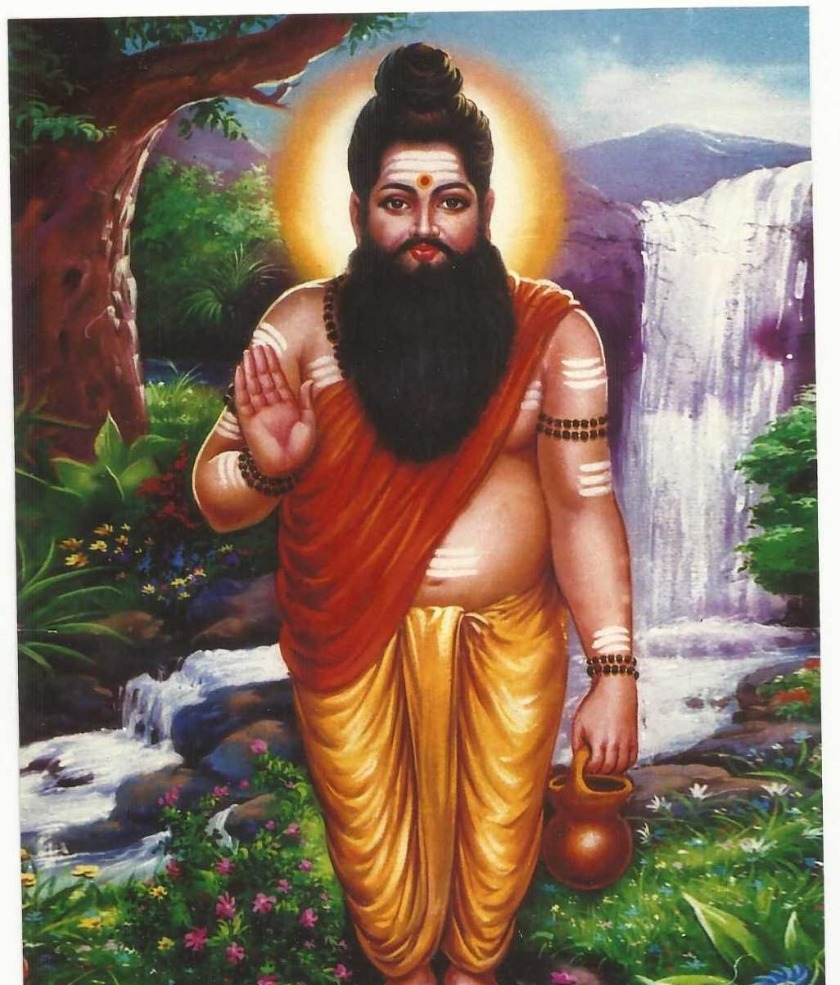
According to spiritual tradition, the rishis departed the physical realm millennia ago and now abide in subtle form in a transcendent realm called Kalapa (known in Tibetan tradition as Shambhala). Though beyond ordinary sensory perception, their consciousness remains intimately connected to humanity.
Naadi readers tune into the rishis’ subtle guidance during palm leaf readings, where the rishis’ presence is maintained in energetic form throughout the interpretation.
Another sacred tradition holds that the Seven Great Rishis (Saptarishis) were mapped across the celestial vault as the stars of the Great Bear constellation.
In the Mahabharata, the rishis are revered as primordial guardians of humanity. Through extensive spiritual discipline and austerities, they acquired transcendent insight, enabling them to foresee and record individual life paths on palm leaves.
Among the greatest rishis are Agastya, Atri, Jaimini, Songinar, Narada, Vashishta, and Vishwamitra. Sage Agastya (“he who moved the mountain”) remains the most revered; he is celebrated as the developer of ancient Tamil scripts, and leaves authored by him and his lineage form the foundation of most authentic palm leaf libraries across India.