
Step-by-Step Process for a Palm Leaf Reading in India
Step 1: Providing Your Thumbprint
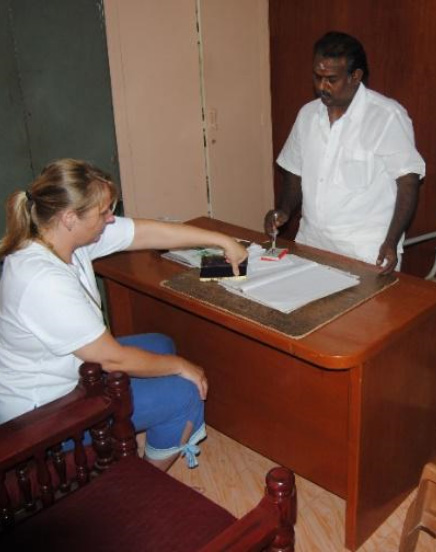
Every authentic palm leaf reading in India is conducted using thumbprints. The thumbprint serves as the fundamental identification key for locating the matching bundles of palm leaves in the libraries for each seeker. Men provide their right thumbprint and women provide their left thumbprint. Each thumbprint contains 108 distinct papillary lines. Based on the intricate structure of these lines, each print is assigned a specific traditional classification name. There exist 9 fundamental categories, 108 sub-categories, and 1008 sub-sub-categories of thumbprint names. The palm leaf bundles stored in individual libraries are organized according to these classifications. Therefore, the thumbprint must be taken clearly so that the papillary ridges are distinctly visible.
We recommend the following procedure for taking your thumbprint:
- Prepare clean white paper and an ink stamp pad (or a standard office stamp ink pad).
- Gently press your thumb onto the ink pad.
- Press your inked thumb onto the white paper, making 2 to 3 impressions per inking.
- Apply the print smoothly from top to bottom (from the upper tip down to the first joint) without rolling or rocking the thumb. Do not press too hard to avoid smudging the ridges.
- Scan the paper with your prints or take a clear high-resolution photo with your smartphone and send it to our email, MMS, or WhatsApp.
Step 2: Locating Your Personal Palm Leaf
Once matching bundles are retrieved from the library shelves, the search for your exact personal leaf begins. Finding the bundles does not automatically mean your specific leaf has been found—it means the correct classification has been identified. Two or more bundles corresponding to your thumbprint category are prepared for the session. From these bundles, the identification process takes place. The reader recites specific verification statements inscribed on the ancient leaves, which the seeker simply confirms or denies with "Yes" or "No". When a statement is confirmed ("Yes"), the reader reads the next detail from the same leaf. When a major detail does not match ("No"), that leaf is set aside and the search moves to the next one.
This ensures that incorrect leaves are dismissed immediately. The verification continues until a leaf is found where every single statement matches your life with 100% accuracy. The data read during verification can be deeply personal, so it is essential to answer truthfully. If an incorrect answer is given—whether consciously or unknowingly—the leaf might be missed. If you are uncertain about a fact during the search, the reader continues checking other statements on the same leaf to avoid misplacement. The time required to find a leaf varies from a few minutes up to an hour depending on which bundle contains your leaf.
Step 3: The Reading of the "General Khandam" (Chapter No. 1)
Once your authentic leaf is verified, the actual interpretation begins. The reading always starts with the General Khandam (Chapter 1). This is a comprehensive life overview covering the period from when you arrive for the reading until the end of your life. The reading is structured into specific life periods ranging from 1 to 5 years. For each phase, detailed predictions are revealed concerning:
- Partnerships and relationships (husband, wife, partner)
- Relationships with close family members (children, parents, siblings, grandchildren)
- Children and their development across various life domains
- Health of the seeker and close family members
- Career and professional path (business ventures, employment, financial success)
- Spiritual journey and personal evolution
- Potential planetary or karmic obstacles and life challenges
The interpretation of this primary chapter is extensive and lasts at least one full hour. For this reason, additional supplementary chapters (2 through 12) are not read on the same day. Throughout the session, you are encouraged to ask any follow-up questions related to the reading, all of which are answered by the reader. If significant planetary obstacles or past-life karmic burdens are revealed, the reading may recommend two vital remedial chapters: Shanthi Khandam and Deeksha Khandam.
These remedial chapters can be interpreted immediately following Chapter 1. Shanthi Khandam details the specific past life that carries the greatest karmic influence on your current life. Deeksha Khandam offers precise recommendations for Vedic remedial rituals (prayers, sacred mantras, offerings, fire ceremonies, etc.). The Shanthi and Deeksha chapters are an essential part of the tradition—the primary purpose of palm leaf readings is not merely to predict the future, but to empower individuals to resolve karmic burdens and fulfill their highest potential.
These remedial practices help dissolve or significantly alleviate karmic blocks. As the Indian readers say: a palm leaf reading is far more than fortune-telling; it is a sacred guide to living a harmonious, purposeful, and joyful life.
And it is entirely up to each of us how we choose to utilize this guidance and assistance.